

Author: VRS
-

PROGRAM NOTES: THE VERONA QUARTET
Franz Joseph Haydn Quartet in B at major Op. 50 No. 1 The art music of Western Europe underwent a period of transition in the mid- 18th century as the thickly embroiled scores of the Baroque, with their long spun-out melodic lines and constant harmonic churn, gradually yielded to the clearer textures, symmetrical phrases and slower…
-
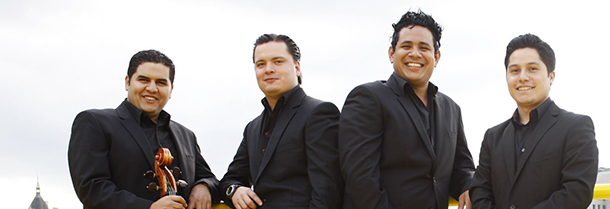
A CHANGE TO OUR FIRST CONCERT IN THE 2017-18 SEASON
The Simón Bolívar String Quartet’s scheduled performance at the Vancouver Playhouse on September 17 has been postponed to a future season. The current volatile and violent situation in Venezuela, which has heightened following last week’s election, has made it almost impossible for the quartet to navigate around Caracas to make arrangements for their North American tour.…
-

PROGRAM NOTES: BENJAMIN GROSVENOR
Robert Schumann Arabesque, Op. 18 In the autumn of 1838 Robert Schumann made a career decision. He would move from his native Leipzig to Vienna to find a publisher and a sympathetic public for his piano compositions. The public he hoped to attract in his year in the Austrian capital was a public of the…
-

PROGRAM NOTES: JAVIER PERIANES
Franz Schubert Piano Sonata in A Major D 664 The salubrious effects of country air on the mind and spirits of the vacationing composer are well known. Witness Schubert’s wonderfully relaxed and lyrical Sonata in A Major D 664 composed in 1819 during a summer sojourn in Steyr, a riverside provincial town set amid the…
-
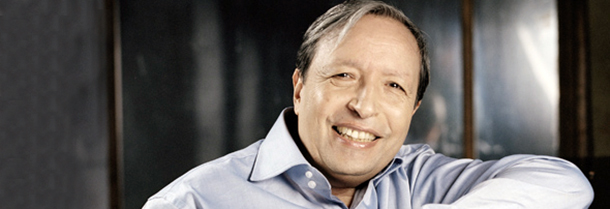
PROGRAM NOTES: MURRAY PERAHIA
Johann Sebastian Bach French Suite No. 6 in E Major BWV 817 The spirit of the dance can be felt across a wide range of Bach’s works, from the fugues of the Well-Tempered Clavier to the Mass in B minor. For Bach lovers with toes eager to tap, then, an entire suite of dance pieces…
-

-
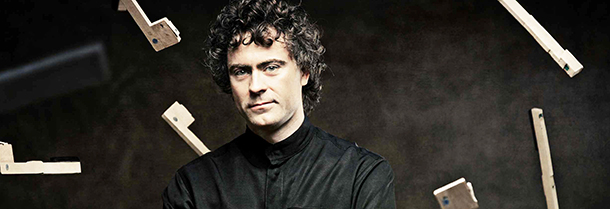
PROGRAM NOTES: PAUL LEWIS
Johann Sebastian Bach Partita No. 1 in B flat major BWV 825 The partita, in late Baroque parlance, was just another name for a dance suite, a multi-movement work made up of the four canonical dance forms—allemande, courante, sarabande & gigue—with the occasional addition of a prelude at the beginning and optional fancier dances called…
-
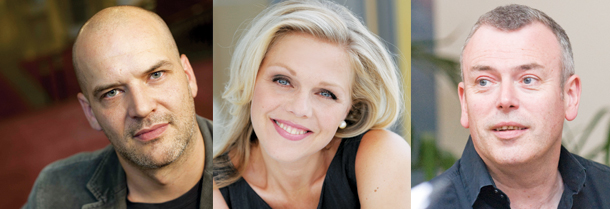
PROGRAM NOTES: FLORIAN BOESCH AND MIAH PERSSON
The Songs of Robert Schumann Robert Schumann was a composer steeped in literature. His compositions bear the dual imprint of both German musical and literary Romanticism. Literature was the family business, one might say, as his father, August Schumann, was both a publisher and a bookseller in Zwickau, Saxony, where the composer grew up. He…
-

PROGRAM NOTES: HARRIET KRIJGH & MAGDA AMARA
Felix Mendelssohn Cello Sonata No. 2 Op. 58 Mendelssohn’s second sonata for cello and piano reveals him as the Classical-Romantic hybrid that he was. An effortless practitioner of Classical etiquette in the construction of symmetrically balanced phrases, he eagerly took part in the Romantic age’s fascination with tonal colour and virtuoso keyboard writing. This sonata…
-

PROGRAM NOTES: BENJAMIN BEILMAN & YEKWON SUNWOO
Franz Schubert Sonata in A major D574 The adolescent Schubert was a busy young man indeed. Fresh from single-handedly inventing the 19th-century German art song (the Lied) at the tender age of 17, he subsequently developed a teenage crush on the violin which in the space of 18 months moved him to compose no less…