

Author: VRS
-

PROGRAM NOTES: DOVER QUARTET & AVI AVITAL
Sulkhan Tsintsadze Six Miniatures for String Quartet and Mandolin (arr. Ohan Ben-Ari) The Soviets promoted the ideal of music rooted in the traditions of their native soil and in this regard it would be hard to find a composer more congenial to Soviet ideals than Sulkhan Tsintsadze, one of the leading composers of the Soviet…
-

PROGRAM NOTES: WINTERLUDE – SUPER SUNDAY WITH ALEXANDER MELNIKOV
Sergei Rachmaninoff Variations on a Theme of Chopin Op. 22 Chopin’s funereal, passacaglia-like Prelude in C minor from his collection of 24 Preludes Op. 28 provides the theme for Rachmaninoff’s first large-scale work for solo piano, his Variations on a Theme of Chopin, completed in 1903. Taking as his point of departure the prelude’s hymn-like…
-
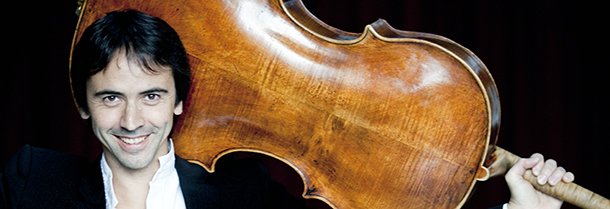
PROGRAM NOTES: WINTERLUDE – SUITE SATURDAY WITH JEAN-GUIHEN QUEYRAS
A Bit of History Few scholars doubt that Western music was better off for the release of a certain “Bach, Johann Sebastian” from the county jail in Weimar where he had languished, in unsuitable company, for the better part of a month in the autumn of 1717. Court organists can be a stroppy crew at…
-

PROGRAM NOTES: JOYCE DIDONATO WITH IL POMO D’ORO CHAMBER ORCHESTRA
WAR, PEACE and BAROQUE OPERA The lust for war, the longing for peace: emotions such as these lie at the extremes of human experience. What better place to explore them than in the luridly violent, yet touchingly pathos- filled world of Baroque opera, where chaos reigns in the personal lives of kings and queens, stand-…
-

PROGRAM NOTES: BEHZOD ABDURAIMOV
Antonio Vivaldi Siciliana in D minor (arr. J. S. Bach and Alfred Cortot) Nothing could be more Baroque than an arrangement of an arrangement. The Baroque was a period in music history in which music travelled freely between instruments and instrumental ensembles. Bach’s Organ Concerto No. 5 for solo organ BWV 596, composed sometime…
-

PROGRAM NOTES: ANNA FEDOROVA
Wolfgang Amadeus Mozart Fantasia in D minor K. 397 Mozart’s D minor Fantasia is a bundle of mysteries; an intriguing sound-puzzle for the listener but a labyrinthine minefield of interpretive choices for the pianist. Mere slavish attention to the details of the printed score—the motto and creed of historically informed pianism—risks missing the point entirely in a…
-

PROGRAM NOTES: ISTVÁN VÁRDAI
Felix Mendelssohn Variations Concertantes Op. 17 Felix was not the only musician in the Mendelssohn family. His older sister Fanny Mendelssohn Hensel (1805-1847) was a prodigiously talented pianist and composer, although she chose marriage over a public career, and his younger brother Paul Mendelssohn (1812-1874) was no slouch as a cellist, to judge by the…
-

PROGRAM NOTES: KSENIJA SIDOROVA
The Concert Accordion Early Beginnings The accordion has for centuries been associated with music of a light or popular nature. Its portability, full harmonic texture and penetrating, reedy timbre have made it the ideal mini-orchestra for country dances and the perfect one-man house band for city cafés and music halls. The very sound of…
-

PROGRAM NOTES: IAN BOSTRIDGE & WENWEN DU
Gustave Mahler Three Des Knaben Wunderhorn Songs The collection of German folk poetry published between 1805 and 1808 under the title Des Knaben Wunderhorn (The Youth’s Magic Horn) had an enormous influence on the development of German lyric poetry and song in the 19th century, and the artless simplicity of these verses was particularly attractive…
-

PROGRAM NOTES: BRYN TERFEL & NATALIA KATYUKOVA
Idris Lewis Cân yr arad goch (Ceiriog) The Welsh poet John Hughes (1832-1887), who took the bardic name Ceiriog, is known as the “Robert Burns of Wales.” Like the great Scottish poet, he sought to express his love for his homeland through poems written in the simple, sincere language of the common people, drawing upon…